
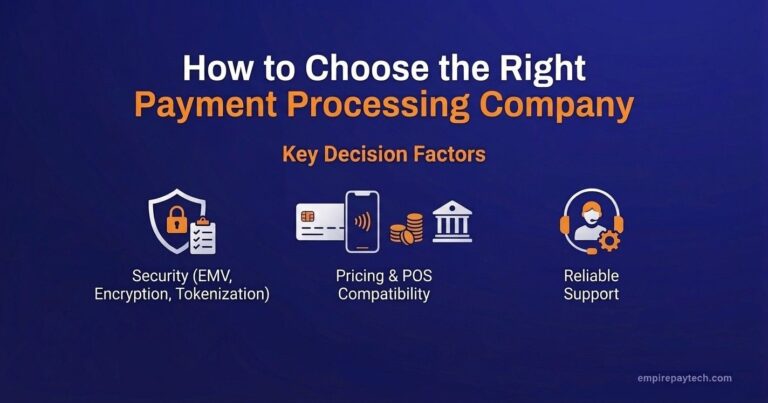
Every card sale your business makes passes through a payment processing company. When that relationship works, you never think about it. When it doesn’t, you find out through declined cards at the register, deposits that arrive late, or a support line that rings out on your busiest evening.
Most owners choose a processor once, early on, and stay with it for years, which makes the decision worth more attention than it usually gets. This guide covers what a payment processor does, what to compare, and the questions that surface the real differences between providers.
What Does a Payment Processing Company Do?
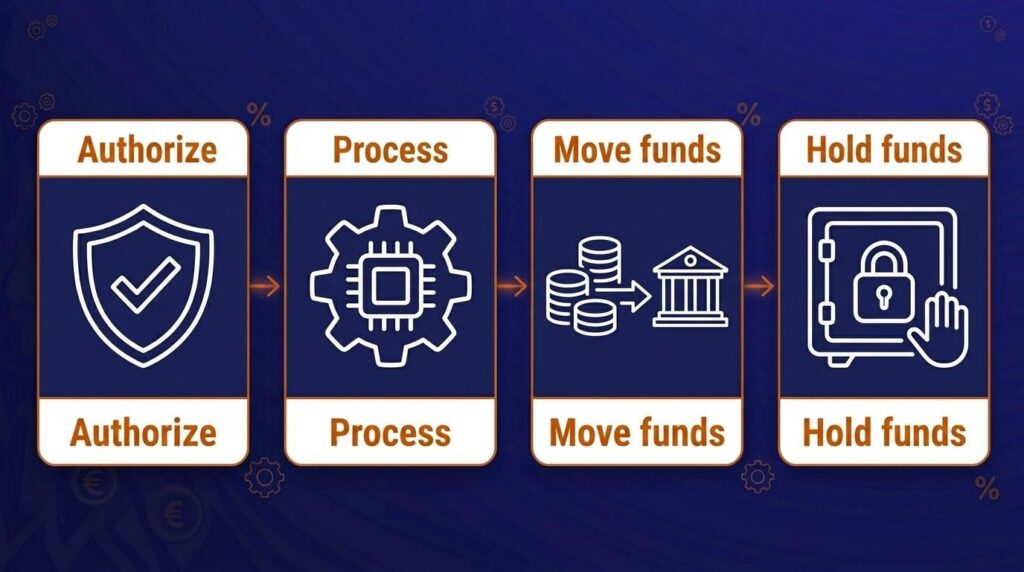
A payment processing company sits between your business, the card networks, and your customer’s bank. Its job has four parts.
Authorization. When a card is tapped or entered online, the processor routes an authorization request to the bank that issued the card and returns an approval or decline in seconds.
Transaction processing. At the end of your day, approved sales are batched and submitted for settlement. This is the step that turns approvals into actual money owed to you.
Moving the funds. The processor deposits settled funds into your merchant account, and from there they transfer to your business bank account. Timing varies by provider and by how your account is set up.
The merchant account. This is the holding account your card funds pass through before reaching your bank. A merchant account provider underwrites it on your business type, sales volume, and average ticket. Most companies bundle the account, processing, and equipment together, which is why “processor,” “merchant services provider”, and “credit card processing company” often describe the same vendor.
Why Choosing the Right Payment Processing Company Matters
Reliability shows up at the counter. Terminal downtime and repeated declines cost you completed sales, not just convenience.
Checkout shapes how customers feel about you. A slow or failed payment is the last thing a customer experiences before leaving.
Security is your liability, not only theirs. Merchants that accept cards are responsible for meeting PCI DSS requirements, so a provider that helps you validate annually saves you real work.
Daily operations run through the same system. Reporting, refunds, tip adjustments, reconciliation, and chargeback responses all live in your processing setup, so awkward tools cost you time every week.
Key Factors to Consider When Choosing a Payment Processor
| Factor | What to Check |
| Payment security | Ask what protections are built into the hardware and gateway: EMV chip acceptance, end-to-end encryption, tokenization, and address and security code verification for keyed or online orders. |
| Supported payment methods | Confirm coverage for credit, debit, contactless, and mobile wallets. If your customers use EBT, fleet cards, or gift cards, check those specifically rather than assuming they’re included. |
| POS system compatibility | Decide whether you need a full POS or just a terminal. Clover, for instance, spans countertop units, handhelds, kitchen displays, and self-order kiosks. A standalone terminal only takes payments, while an integrated POS also handles reporting, inventory, and staff management. If you already own equipment, ask whether it can be reprogrammed rather than replaced. |
| Customer support | Find out the hours, whether support is in-house, and what happens when hardware fails outside business hours. Some providers, including Empire Paytech, run 24/7 US-based support; others route you to a queue during office hours only. |
| Pricing transparency | Payment processing fees come in a few structures. Interchange plus lists interchange separately with the provider’s margin on top. Flat rate and tiered pricing fold everything into one number, which is easier to read but hides where the money goes. Ask for the full fee schedule, not the headline rate. |
| Scalability | Consider where the business will be in three years. Adding a location, a register, or an online store changes what you need, and each location under a single ownership generally requires its own merchant account. |
| Integration options | If you use accounting software, ecommerce platforms, or online invoicing tools, confirm your payment gateway connects to them. Ask which gateways the provider supports by name rather than accepting a general yes. |
Questions to Ask Before Selecting a Payment Processing Provider
Take these into any sales conversation. Vague answers are informative in themselves.
- Who underwrites my merchant account? Providers are typically registered ISOs of a sponsoring bank and should disclose that relationship plainly.
- What is the complete fee schedule, including monthly minimums, statement fees, PCI fees, and annual fees?
- Is there a contract term, and what does early cancellation cost?
- How quickly are funds deposited, and does that change for certain card types?
- Am I buying the equipment, leasing it, or using it only while I process with you?
- What happens to my rate after the first year?
- How are chargebacks handled, and what support do I get in responding?
- Can I keep my current terminals?
Common Mistakes Businesses Make When Choosing Payment Processing Services
Comparing headline rates instead of total cost. A low advertised rate paired with monthly fees, minimums, and PCI charges can cost more than a higher rate with fewer add-ons. The fair comparison is total monthly fees against total monthly card sales. Our guide to reducing credit card processing fees covers this in more detail.
Treating security as the provider’s problem. PCI compliance obligations sit with the merchant. Skipping the question at signup usually means discovering non-compliance fees later.
Not checking integrations first. Signing up and then finding the gateway won’t connect to your accounting software or store platform is a common and avoidable problem.
Discounting support until it’s needed. Support quality feels abstract during a sales call and very concrete when a terminal dies mid-service.
Making the Decision
Pull your last two or three statements, list what you actually need from payment solutions for businesses your size, then put the same questions to every provider on your list. The one that answers plainly, in writing, with a fee schedule you can read is usually the one worth signing with.
Frequently Asked Questions
1. What is the difference between a payment processor and a merchant services provider?
In practice, very little. A payment processor handles the transaction itself, while a merchant services provider supplies the account, equipment, security, and support around it. Most companies do both.
2. How much do payment processing fees usually cost?
It depends on your card mix, average ticket, and whether sales are card present or online, so no single figure applies. Instead of comparing advertised rates, divide your total monthly fees by your total monthly card sales to get your effective rate.
3. Can I switch payment processing companies without new equipment?
Often yes. PCI-compliant terminals can frequently be reprogrammed for a new processor, though some devices are locked to the provider that supplied them.
4. How long does it take to get approved?
Many providers can set up an account within a couple of business days once the signed application and supporting documents are received. Equipment delivery may add time.
5. Do I need a separate merchant account for each location?
Generally yes. Each location under a single ownership normally needs its own account, as does a separate business line selling different products or depositing to a different bank.