
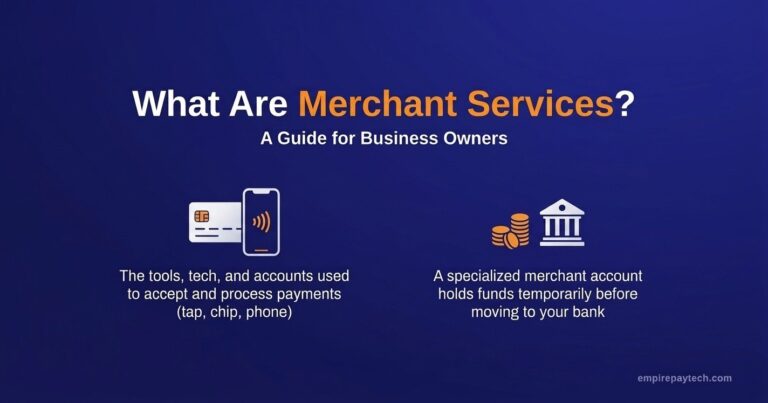
Merchant services are the tools, technology, and accounts businesses use to accept and process customer payments: a merchant account, the processing connection that carries each transaction, and the hardware or software you take payments on. If your business can accept a tap or a chip card, you already use merchant services, whether or not anyone called them that when you signed up.
This matters more than it did ten years ago for a simple reason. Fewer customers carry cash, and more expect to pay with a phone. A cash-only business isn’t just inconveniencing people. It’s turning away sales at the counter.
What Are Merchant Services?
“Merchant services” is an umbrella term for everything sitting between your customer’s card and the money reaching your business bank account. Four pieces usually make up the package:
- A merchant account: a specialized account that holds card funds temporarily before they transfer to your regular business bank account.
- Payment processing services: the technology that carries transaction data between your business, the card networks, and your customer’s bank.
- Hardware or software: a countertop terminal, a POS system, a gateway on your website, or a card reader paired to a phone.
- Support and security: PCI compliance help, fraud tools, chargeback handling, and someone to call when a terminal stops working mid-shift.
The account and the processing get confused because they arrive together, but they do different jobs: the account is where the money sits; the processing is how the transaction information travels.
One detail that surprises owners is that each location under a single ownership generally needs its own merchant account. Open a second store, and you’ll usually open a second account.
How Do Merchant Services Work?
The flow takes a few seconds, but several parties are involved.
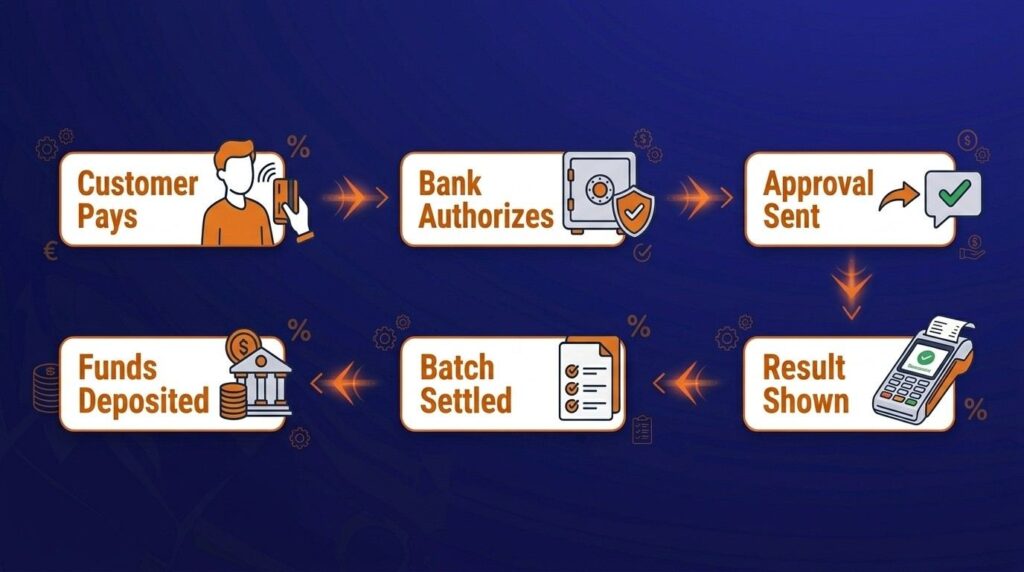
- The customer pays. A tap, a chip card, or a card submitted at online checkout.
- An authorization request goes out from your terminal or gateway to the customer’s card-issuing bank.
- The issuing bank approves or declines, checking for available funds and signs of fraud.
- The answer comes back to your terminal or website. This is the part your customer sees.
- You settle the day’s transactions. At close, approved sales are batched and sent to the processor.
- Funds are deposited into your merchant account, then moved to your bank.
A worked example: a customer buys a $40 lunch at 1 p.m., and the card approves instantly, but the restaurant doesn’t have the $40 yet. It has an authorization. The money moves after that evening’s batch. Many providers, including Empire Paytech, fund Visa, Mastercard, Discover, and American Express transactions as soon as the next business day.
Fees come out along the way. The largest share goes to the bank that issued your customer’s card, as interchange; smaller portions go to the card networks, the processor, and your provider. That split explains why no provider can price far below everyone else. Most of the cost is not theirs to discount.
What Is Included in Merchant Services?
Credit card processing services cover Visa, Mastercard, American Express, and Discover, including rewards cards that carry higher interchange costs.
Debit card processing covers PIN and signature debit, which usually costs less than credit. That’s why a business with heavy debit volume can have a very different effective rate than a neighbor with similar sales.
Merchant accounts are underwritten on your business type, processing history, and average ticket size, and typically take a couple of business days to approve once documents are in.
POS systems for businesses range from a basic terminal to a full system that tracks inventory, manages staff hours, and runs reports. Clover is one of the more widely used platforms, with countertop, handheld, and mobile versions plus kitchen displays and self-order kiosks. Standalone terminals suit businesses that only need to take payments, without inventory or staff management.
Online payment solutions connect your website to a payment gateway, usually with a virtual terminal for keyed-in orders, recurring billing, and fraud controls like address and security-code verification.
Mobile payment solutions let you take payments away from the counter: a reader on a phone at a market stall, or a handheld a server carries to the table.
Why Do Businesses Need Merchant Services?
You meet customers where they are. Some pay with debit, some with a rewards credit card, some with a phone. Accepting one and not the others costs you sales you never hear about.
Checkout gets faster. A tap clears in seconds; counting cash and making change doesn’t, and the difference shows during a lunch rush.
Card data stays protected. Chip cards, end-to-end encryption, and tokenization exist because card fraud is expensive, and meeting PCI DSS requirements isn’t optional for a business that accepts cards.
Daily operations get easier. Sales reporting, deposit reconciliation, tip adjustments, refunds, and chargeback responses all run through your setup.
Merchant Services vs Payment Processing: What Is the Difference?
Payment processing is one function inside merchant services. Processing is specifically the movement and authorization of transaction data. Merchant services is the whole arrangement: the account, the processing, the equipment, the security requirements, the reporting, and the support behind them.
The terms get used interchangeably in practice. The distinction becomes useful when comparing quotes. A cheap processing rate attached to poor support, dated equipment, or an account that freezes deposits without warning is not a cheap deal.
How to Choose the Right Merchant Services Provider
| Criteria | What to Check |
| Security and compliance | Ask how PCI validation is handled, what encryption the equipment uses, and who underwrites your account. Providers are typically registered ISOs of a sponsoring bank, and that relationship is usually disclosed on their website. |
| Support you can reach | Check the hours and whether support is in-house or outsourced. A terminal down on a Friday night is a revenue problem, not a ticket. |
| Technology that fits how you sell | Small business payment solutions aren’t one-size-fits-all: a single-register shop, a restaurant with tableside ordering, and an online store all need different setups. |
| Pricing you can read | Interchange-plus shows interchange separately with the provider’s margin on top. Flat-rate and tiered pricing bundle everything into one number, which is simpler but hides where the money goes. Either way, ask about monthly minimums, statement fees, PCI fees, annual fees, and early termination charges before signing. |
| Your own requirements | Monthly volume, average ticket, the split between card-present and online sales, and whether you plan to add locations all affect which structure suits you. |
Your most useful comparison tool is your current statement. Divide total monthly fees by total monthly card sales, and you get your effective rate, one number that makes two quotes genuinely comparable.
Conclusion
Merchant services sit quietly underneath every sale, which is why they’re worth reviewing on purpose rather than by accident. Know what’s in your package, know your effective rate, and check that the equipment still matches how your business runs today.
Frequently Asked Questions
1. Do I need a merchant account to accept credit cards?
Yes, in some form: either a dedicated merchant account or access to one through an aggregator. A dedicated account is underwritten for your business specifically, which generally means steadier deposits and fewer sudden holds.
2. How long does it take to set up merchant services?
Most accounts can be set up within a couple of business days after a signed application and supporting documents are received. Equipment shipping may add a little time.
3. What documents do I need to apply?
Typically, your business name and address, ownership details including Social Security number and ownership percentage, your tax identification number, bank account details, a photo ID, and a voided check.
4. Can I keep my existing card terminal if I switch providers?
Often yes, as long as the equipment is PCI compliant and can be reprogrammed for the new processor. Some devices are locked to a specific provider, so confirm first.
5. Do I need two merchant accounts if I sell in store and online?
Not necessarily. One account usually covers both if it’s the same business selling the same products into the same bank account. You’d need a separate account for a different line of goods or a different deposit account.