
Credit card processing fees are one of the few business expenses that scale directly with success. Sell more, pay more. For a restaurant or retail shop running thin margins, the difference between a well-managed processing setup and a neglected one can be the cost of a part-time shift every month.
Most of the fee is not negotiable, and any provider promising to eliminate it entirely is glossing over how the system works. What you can control is the portion that comes from your own setup, your pricing structure, and the habits around your account.
What Are Credit Card Processing Fees?
The amount on your statement is not one fee. It is four, collected by four different parties.
Interchange fees go to the bank that issued your customer’s card and are the largest share of what you pay. Rates are set by the card networks and vary by card type, business category, and how the transaction was taken. A tapped debit card and a keyed-in rewards credit card carry very different interchange rates.
Card network fees are the smaller assessments Visa, Mastercard, Discover, and American Express charge for running the networks. Like interchange, they are fixed and identical for every business.
Processor fees cover the authorization and settlement work, usually as a percentage plus a per-transaction amount.
Merchant service fees are what your provider charges on top: monthly account fees, statement fees, PCI fees, gateway fees, batch fees, and sometimes a monthly minimum.
Only the last two are open to discussion, which is why quotes from serious providers tend to land in a similar range.
10 Ways Businesses Can Reduce Credit Card Processing Fees
1. Understand Your Current Processing Fees
Divide total monthly fees by total monthly card sales, and you have your effective rate. It captures everything, including the merchant fees buried on page three, and it is the only figure that makes two providers comparable.
2. Compare Different Payment Processing Providers
Ask each provider for a complete fee schedule in writing, not a headline rate, and request the same details from all of them: monthly minimums, annual fees, and what happens to your rate after year one.
3. Choose Suitable Payment Processing Solutions
How a transaction is captured affects its cost. Card-present sales carry lower interchange than keyed or online ones, so if you are typing in numbers that could be dipped or tapped, you are paying for the difference.
4. Improve Payment Security
Address and card security code verification on keyed and online orders help transactions qualify for better interchange instead of being downgraded, and EMV acceptance keeps counterfeit card liability where it belongs. Skipping them on card-not-present sales is a common source of avoidable credit card processing costs.
5. Reduce Chargebacks
Every chargeback brings a fee, and a pattern of them can put your account under review. Use a statement name customers recognize, give clear receipts, keep refund terms visible, and answer disputes with documentation.
6. Review Monthly Processing Statements
Statements are where creeping payment processing fees show up: new line items, non-compliance charges after a missed PCI questionnaire, rate increases nobody announced. Providers fix billing errors, but usually only when asked.
7. Use Updated POS Technology
Terminals that cannot take contactless or chip payments push transactions into higher cost categories, and sales left unbatched overnight can be downgraded for late settlement. Current systems, from a full POS platform like Clover to a standalone terminal, settle automatically.
8. Accept Efficient Payment Methods
Debit generally processes cheaper than credit, and premium rewards cards sit at the top of the interchange range. You cannot dictate what customers use, but on large or recurring invoices it is reasonable to offer a lower-cost option.
9. Understand Your Pricing Structure
Interchange plus separates interchange from your provider’s margin. Flat rate is simpler but averages everything. Tiered pricing sorts transactions into buckets you do not define. If you sell to other businesses, ask about Level 2 and Level 3 data, which can qualify commercial card transactions for lower interchange.
10. Work With the Right Merchant Services Provider
The provider decides how much of the above is workable. What matters is a readable fee schedule, help with PCI validation, support that answers when a terminal fails, and someone who will walk you through a statement. On rate alone, credit card processing services are close to a commodity.
Common Mistakes That Increase Payment Processing Costs
| Mistake | Cost Impact |
| Not reading statements | Fees rarely arrive in one obvious jump. They accumulate, and an unopened statement is where that happens. |
| Choosing a pricing model that does not fit | Flat rate suits small tickets and a predictable card mix. High volume or heavy debit traffic often does better on interchange plus. Picking on simplicity alone can cost more than it saves. |
| Treating security as optional | Skipping verification tools on card-not-present sales, running outdated equipment, or missing a PCI questionnaire all carry direct costs, such as downgrades, non-compliance fees, or fraud losses. |
Can Businesses Eliminate Credit Card Processing Fees?
Not entirely, and any claim otherwise deserves scrutiny. Interchange and network fees exist wherever you process.
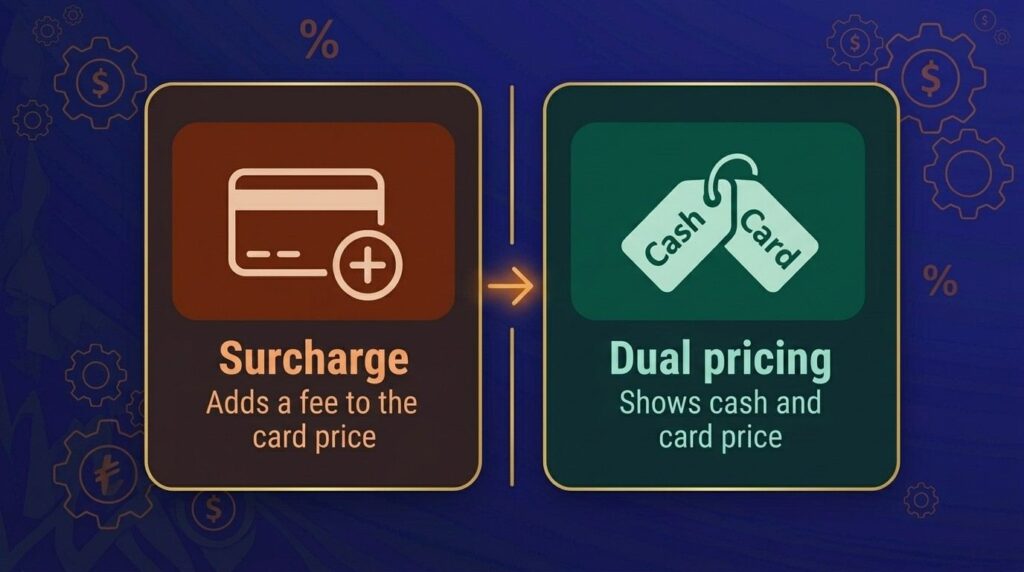
What some businesses do instead is shift part of the cost to the customer who chooses to pay by card. A surcharge adds a fee to card transactions. Dual pricing displays a cash price and a card price and lets the customer pick. Empire Paytech offers a dual pricing program, and many providers now support one or both models.
Both come with real rules. Debit surcharging is prohibited nationwide under card network rules, including when a debit card is run as credit. The networks cap credit surcharges, and for a business accepting both Visa and Mastercard, the practical ceiling is 3%. A surcharge cannot exceed your actual cost of accepting that card, and disclosure is required at the point of entry and at checkout. State law adds another layer: a few states restrict or prohibit surcharging, several cap it or set specific disclosure rules, and some of those statutes are being litigated.
Because the position varies by state and keeps changing, confirm the current rules everywhere you operate before implementing either model, and take legal advice where the exposure is significant. Done properly, it can lower payment processing costs substantially. Done carelessly, it creates compliance risk and complaints.
Managing Processing Costs Over Time
Processing costs are not a one-time negotiation. Read the statement monthly, recheck your effective rate once or twice a year, and revisit the setup when the business adds a location or starts selling online. The businesses paying the least are rarely the ones who got the sharpest opening deal. They are the ones still paying attention two years later.
Frequently Asked Questions
1. What is a typical credit card processing rate?
There is no single figure. Cost depends on card mix, average ticket, and whether sales are card present or online, so calculate your own effective rate instead of comparing against an advertised number.
2. Can I negotiate credit card processing fees?
Partly. Interchange and network fees are identical for every merchant. Your provider’s margin and account fees are negotiable, particularly at renewal or with competing quotes in hand.
3. Why did my processing fees increase without notice?
Usually a shift in card mix toward premium rewards cards, a non-compliance fee after a missed PCI questionnaire, an annual fee posting, or a scheduled adjustment in your agreement. Comparing two consecutive statements shows which.
4. Is it legal to charge customers a credit card fee?
In most of the United States, yes, subject to card network rules and state law. Debit surcharging is prohibited nationwide, and some states restrict or cap credit surcharges and require specific disclosures, so verify your state’s rules first.
5. Does switching processors actually lower my costs?
Sometimes, but only if the new schedule is lower across every line, not just the headline rate. Compare total fees against total card sales under both offers first.