A restaurant owner in Denver called her processor in July asking to add a 3% card fee. She’d seen a competitor doing it and figured it was time to stop absorbing the cost herself. Her rep had to walk her back: Colorado caps surcharges at 2%, not 3%, and she’d need to send written notice 30 days before flipping the switch. By the time she got compliant, she’d lost most of a summer’s worth of margin she was trying to recover in the first place.
That’s the situation a lot of small business owners are in right now. Card processing costs have been climbing for years, surcharging finally feels like a legitimate option instead of a shady workaround, and the rules governing it changed again in 2026 — and got stricter, not looser. Meanwhile, a quieter alternative — dual pricing, sometimes called a cash discount program — has been sitting there the whole time, legal in every state, without a 30-day notice period or a card network audit hanging over it.
This is a plain-language breakdown of both options as they actually stand in 2026, including where surcharging is banned outright, where it’s capped, and why dual pricing has become the default recommendation for merchants who don’t want to think about this again next year.
Surcharging in 2026: The Rules Got Real
Surcharging — adding a fee specifically for paying with a credit card — has always been legal at the federal level, but it’s governed by two overlapping layers of rules: what the card networks allow, and what your state allows. Both layers matter, and missing either one is how merchants end up fined.
The card network rules. Visa currently caps surcharges at 3% of the transaction. Mastercard allows up to 4%. But neither of those numbers is really the ceiling — the actual rule is that your surcharge can never exceed what card acceptance genuinely costs you. Whichever number is lower, the network cap or your real cost, is the one you’re bound by. If your blended processing rate is 2.1%, charging 3% because “that’s what Visa allows” is itself a violation.
On top of the cap, there’s a process:
- 30 days’ written notice to your payment processor before you turn surcharging on, including your business name and address, whether you’re surcharging by card brand or by product type, and the exact percentage.
- Pick one method, not both. You can surcharge by brand — a flat rate applied across Visa, Mastercard, Amex, and so on — or by product type — credit cards get surcharged, debit and prepaid don’t. You can’t mix the two.
- Disclosure before the card is presented. Customers need to see the surcharge coming — at the point of entry, at checkout, and itemized on the receipt. A fee that only shows up after the sale is final is the fastest way to trigger a chargeback or a complaint.
What’s changed for 2026 specifically is enforcement. Visa has flagged this as a high-enforcement year, and the numbers back it up: first-offense fines start around $1,000 per location, and repeat or willful violations can end with the merchant account being terminated outright. That’s a meaningful shift from a few years ago, when surcharge rules existed on paper but rarely got enforced against small operators.
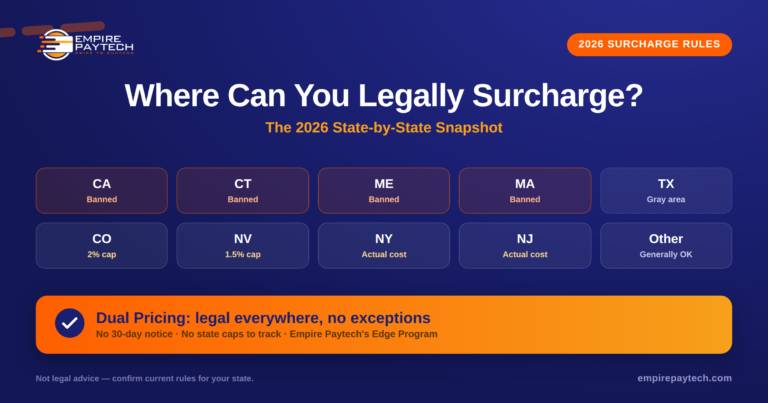
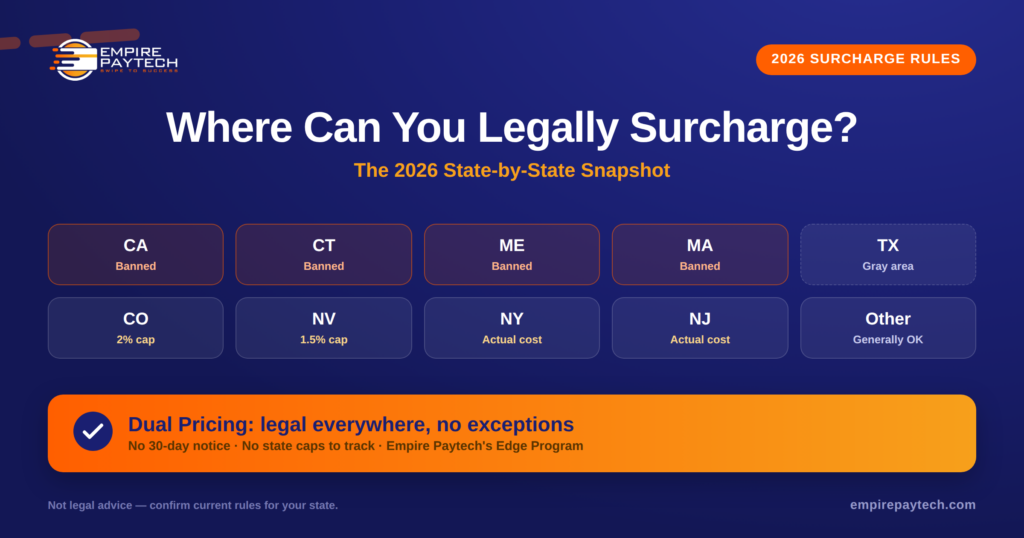
Where Surcharging Is Banned or Restricted
Even if you clear the network rules, your state might not allow surcharging at all — or might allow it with limits Visa and Mastercard don’t impose. This is the part that trips people up most, because a program that’s perfectly fine in one state is a violation the moment you open a second location across a state line.
This is a general summary, not legal advice — state rules change, and you should confirm your specific situation with a qualified attorney before implementing any fee structure.
| State | Status |
|---|---|
| California | Surcharging banned (SB 478) |
| Connecticut | Surcharging banned |
| Maine | Surcharging banned (cash discounts still allowed) |
| Massachusetts | Surcharging banned |
| Colorado | Allowed, capped at 2% |
| Nevada | Allowed, capped at 1.5% without added documentation |
| New York | Allowed, capped at actual acceptance cost, strict disclosure rules |
| New Jersey | Allowed, capped at actual acceptance cost |
| Most other states | Generally allowed under network rules |
Texas is its own case worth flagging, since Empire Paytech is a Texas company and a lot of our merchants operate here. Texas Business & Commerce Code 604A.0021 technically prohibits surcharging. But in 2018, a federal court (Rowell v. Paxton) blocked the state from enforcing that law against the merchants who brought the suit, on First Amendment grounds. The Texas Attorney General’s office pushed back in 2019 with an opinion arguing the ruling was narrow and shouldn’t be read as a blanket green light. Nobody has fully settled it since. The practical result: surcharging happens in Texas every day and mostly goes unchallenged, but the underlying law is still on the books, penalties up to $500 per violation are still technically live, and “probably fine” isn’t the same as “actually legal.” If you want zero ambiguity in a state like this, surcharging isn’t it.
Dual Pricing: The Version That Skips All of This
Dual pricing — also called a cash discount program — solves the same underlying problem (card processing costs eating into margin) through a completely different legal structure. Instead of charging a fee for using a card, you post two prices: a cash price, and a slightly higher card price. The customer picks. Nothing is added at checkout — the “surcharge” was baked into the sticker price from the start, and paying cash earns a discount off it.
That distinction — a discount for cash instead of a fee for card — is why dual pricing is treated differently under both card network rules and most state laws. It’s legal in all 50 states, including the four that ban surcharging outright, because it’s structured as a price difference disclosed upfront, not a punitive add-on charged after the customer has already committed to paying with plastic.
Practically, that means:
- No 30-day advance notice requirement.
- No brand-level vs. product-level election to get wrong.
- No state-by-state compliance map to maintain if you operate in more than one location.
- No 2026-specific enforcement crackdown to worry about, because it isn’t the thing being cracked down on.
It’s not a loophole — it’s a genuinely different pricing model, and it’s why it’s become the go-to recommendation for small businesses that want to offset card costs without adding legal risk to the list of things they have to track. Empire Paytech’s Dual Pricing program (we call it the Edge Program) sets this up with no contract, no monthly minimum, and no cancellation fee, so a merchant who tries it isn’t locked into anything if their pricing strategy changes later. [INTERNAL LINK: /services/dual-pricing “Learn how the Edge dual pricing program works”]
So Which One Should You Actually Use?
If you’re in a state that permits surcharging and you’re confident you can maintain the notice, disclosure, and documentation requirements indefinitely — including if you expand into a state that bans it — surcharging can work, and some merchants do run it successfully. But for most small operators, especially ones running a single location or a lean back office without a compliance team, dual pricing gets you the same financial outcome (customers effectively cover more of the card cost) with a fraction of the regulatory surface area.
That’s especially true if you’re in a legal gray zone like Texas, or if you have any plans to open a second location somewhere the rules might differ. Surcharging asks you to get four separate things right — the cap, the notice period, the brand/product election, and the disclosure — and keep getting them right as rules shift. Dual pricing asks you to post two prices.
Getting Set Up Without Guessing
Whichever direction makes sense for your business, the equipment and processing setup matters as much as the pricing model. Empire Paytech runs Interchange Plus and Custom Pricing alongside the Dual Pricing program, works on Clover POS hardware, and includes PCI compliance support so the technical side isn’t left to chance either.
Since we’re based in Sugar Land, we get a lot of these Texas-specific questions directly, and the honest answer is usually the same one above: dual pricing is the version that doesn’t require you to keep checking whether the rules changed again.
If you want a second opinion before you flip a switch either way, call +1 (866) 294-0466 or request a free quote — we’ll walk through both models against your actual numbers before you commit to either one.
FAQs
Is credit card surcharging legal in 2026?
It depends on your state and how carefully you follow the network rules. Surcharging is legal under Visa and Mastercard rules nationwide (subject to their caps and disclosure requirements), but it’s banned outright in California, Connecticut, Maine, and Massachusetts, and restricted further in states like Colorado, Nevada, New York, and New Jersey. Some states, like Texas, sit in a legal gray area where the law technically bans it but enforcement has been blocked by a court ruling. This isn’t legal advice — confirm your state’s current rules before implementing a surcharge.
What’s the difference between a surcharge and a cash discount program?
A surcharge adds a fee at checkout specifically for paying by card. A cash discount (dual pricing) program posts two prices upfront — a cash price and a slightly higher card price — so the customer is choosing a discount rather than being charged a fee. That structural difference is why dual pricing is legal in states that ban surcharging.
How much can a business legally surcharge in 2026?
Visa’s cap is 3% of the transaction and Mastercard’s is 4%, but the real limit is whichever is lower: the network cap or your actual cost of accepting cards. You also can’t exceed your state’s cap if it’s stricter than the network rules — Colorado’s is 2%, for example.
Do I need to notify my processor before adding a surcharge?
Yes. Card network rules require 30 days’ written notice before you start surcharging, including your business name and address, whether you’re surcharging by card brand or by product type, and your exact surcharge amount.
Sources consulted for 2026 figures: 2026 Visa Surcharge Rules — Lifelong POS, Credit Card Surcharge Laws by State — VMS, Texas Credit Card Surcharge Laws — Nickel, Merchant Services Trends 2026 — The POS Brokers.